
Lunch & reset
Tian An 1000 Trees
天安千树
The most useful midpoint: memorable architecture, lunch, toilets and a weather-proof place to reset.
Explore this stopShanghai / The river edition
Morning on two wheels.
An afternoon on foot.
Shanghai, at your own pace.
Lunch & reset
天安千树
The most useful midpoint: memorable architecture, lunch, toilets and a weather-proof place to reset.
Explore this stopChoose a paper landmark to explore the river.
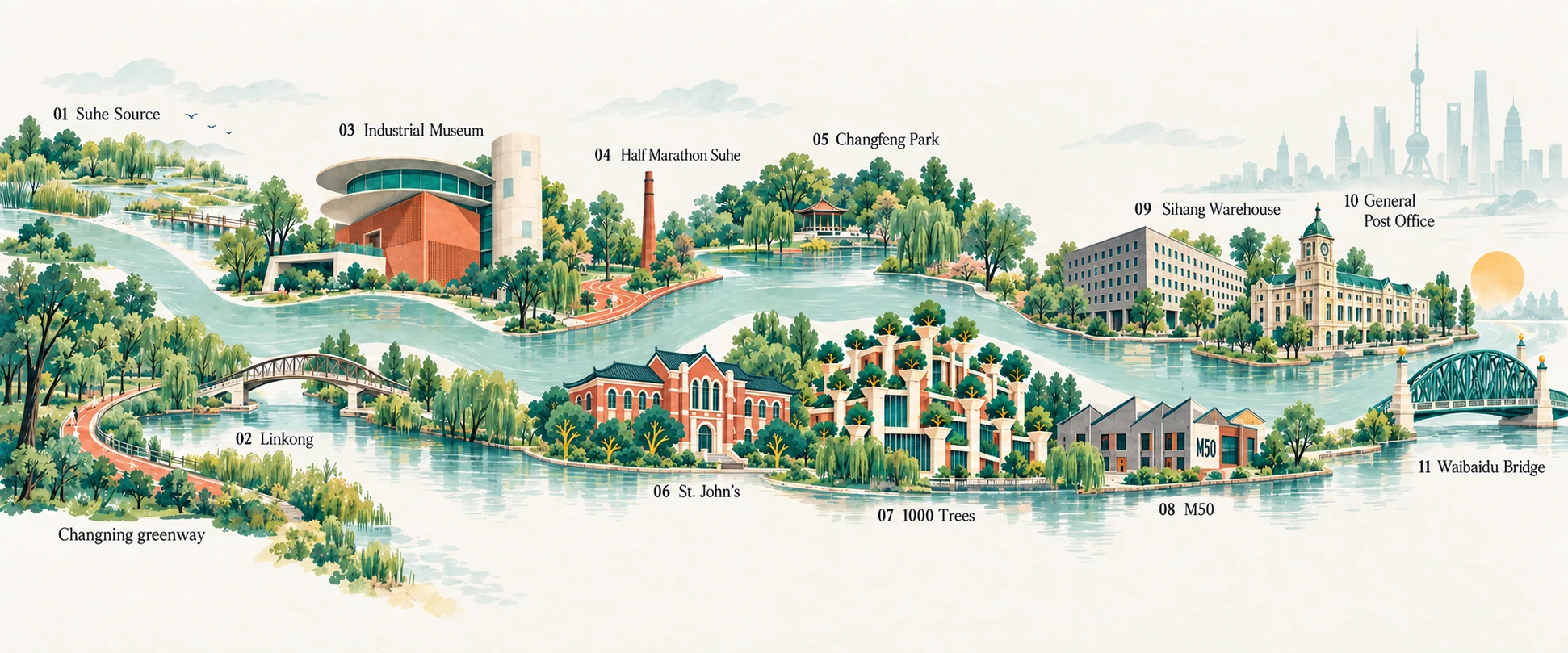
Illustrated route · distances and bends simplified. Follow the numbered itinerary, not the spacing of the painted buildings. Trees suggest riverside greenery, not park boundaries. Not for navigation. Geographic references: © OpenStreetMap contributors · ODbL
Plan your riverside day
Suzhou River offers a different view of Shanghai: riverside parks, former factories, art spaces and historic buildings on the way to the Bund. Use this illustrated map to choose a short walk, an afternoon around 1000 Trees and M50, or a one-day itinerary with a quieter start upstream.
Suzhou Creek / 苏州河 is the same Shanghai waterway as Suzhou River. These walks do not take you to Suzhou city. The time allowances below cover the suggested outings, not your hotel transfers; use a live map for station entrances, bridge crossings and current riverside access.
Choose a few stops. Leave room to wander.

01 / Morning ride
Ride the greener upper creek and choose two or three stops—not every park.
Explore this stretch
02 / Lunch & reset
Eat, cool down and return the bike at Tian An 1000 Trees.
Explore this stretch
03 / Afternoon walk
Move through art, industry and riverside history on foot.
Explore this stretch
04 / Sunset & night
Finish at the river mouth; sunset time varies with the season.
Explore this stretchMorning ride
苏河源公园
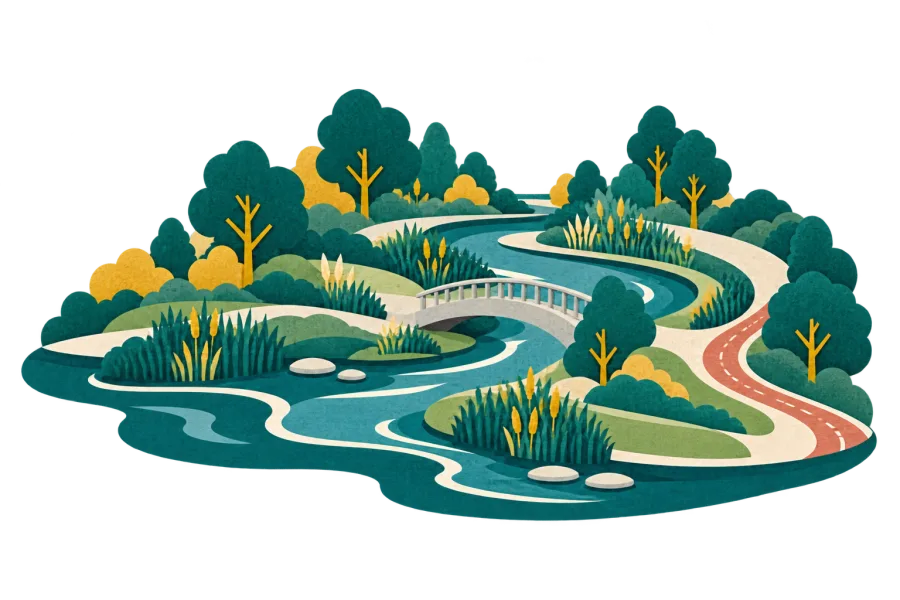
Why stop: Begin where central Shanghai loosens into water, planting and open sky.
What to do: Start the ride gently, check the riverside access and take in the quieter western edge of the city.
Allow: 20–30 min before riding · Start point · bicycle
Confirm the current opening areas and usable entrances before you set out.
Morning ride
临空音乐公园
Why stop: A broad, active stretch that makes the ride feel like part of the day—not just transport.
What to do: Follow the greenway, pause for the open river view and keep the pace easy.
Allow: 20–40 min · Continue by bicycle
Morning ride
苏州河工业文明展示馆

Why stop: A compact explanation of how factories shaped the creek—and how the industrial waterfront changed afterward.
What to do: Lock the bike, begin with the outdoor machines and use the indoor galleries only if the museum is open and the morning still has room.
Allow: 35–50 min · Bicycle · short museum visit
Usually closed on Mondays. Address: 2690 Guangfu West Road. The map position is approximate; confirm the entrance before travelling.
Morning ride
半马苏河公园

Why stop: A preserved industrial chimney, lawns and running paths make the creek's shift from work zone to public space easy to read.
What to do: Walk the riverside lawns. The map marks No. 1 Park; the chimney shown in the illustration is in No. 2 Park at 160 Daduhe Road, farther west. Use permitted cycle routes between parks and dismount in walking-only areas.
Allow: 20–40 min · Bicycle · riverside pause
Morning ride
长风公园

Why stop: Yinchu Lake and Tiebi Hill offer a classic neighborhood-park contrast to the linear riverfront.
What to do: Take one short lakeside loop rather than crossing the entire park, then return to the creek for the ride east.
Allow: 30–45 min · Bicycle · short park walk
The park is being upgraded in phases, with overall completion planned for the end of 2026. Check current entrances before visiting.
Morning ride
华政长宁校区与圣约翰大学旧址

Why stop: Red-brick campus buildings give the river a calm, scholarly pause before the city becomes denser.
What to do: Park the bike briefly and walk the public riverside section beneath mature trees.
Allow: 30–45 min · Bicycle · on foot by the campus
Lunch & reset
天安千树
Why stop: The most useful midpoint: memorable architecture, lunch, toilets and a weather-proof place to reset.
What to do: End the cycling section here, eat slowly and switch to walking for the historic lower creek.
Allow: 60–90 min · Return bicycle · continue on foot
Afternoon walk
M50创意园
Why stop: A compact way to see how riverside industry was reused for art and creative work.
What to do: Walk through one or two galleries, then return to the creek rather than trying to see every room.
Allow: 45–75 min · On foot
Afternoon walk
四行仓库

Why stop: A heavy riverside building that makes Shanghai's wartime history physically legible.
What to do: Read the exterior first; decide on the museum only if time and current entry arrangements allow.
Allow: 30–60 min · On foot
Sunset & night
上海邮政总局

Why stop: Its domed tower signals the transition from the warehouse river to Shanghai's grand urban core.
What to do: See the facade from across the water and continue east as the light softens.
Allow: 20–35 min · On foot
Sunset & night
外白渡桥
Why stop: The river opens into the Huangpu here, giving the day a natural skyline finale.
What to do: Arrive around blue hour, cross the steel bridge and finish with the Bund lights.
Allow: 30–60 min · Walk · finish here
Good to know
Yes. Suzhou Creek and Suzhou River are English names for 苏州河, the waterway in Shanghai shown here. This is separate from Suzhou city in Jiangsu and a Suzhou day trip from Shanghai.
Suzhou River runs through western and central Shanghai and meets the Huangpu River at Waibaidu Bridge, beside the northern end of the Bund. This guide brings together selected riverside parks, buildings and walks, not every stretch of the river.
The two destinations can be paired for a riverside art-and-architecture outing. Shanghai’s official visitor guide describes a riverside walkway connecting 1000 Trees and M50. Check access signs on the day and allow extra time for galleries and lunch.
Do not assume every waterfront path allows cycling. Ride only where permitted, dismount on pedestrian-only sections and check park entrances. The Changning greenway has its own bicycle rules; it is an optional detour, not a mandatory part of this itinerary.
No. The map is a menu of places, not a checklist. For a first visit, choose a small upper-creek cluster or a short lower-creek walk. A full day works better with selected stops and transport between stretches.
Connection reference: Shanghai visitor information on 1000 Trees and M50. Access can change.
Use the bike for the upper creek, return it in an allowed parking area around lunch, then walk the lower creek. The river line is not a continuous cycle lane.